
Description
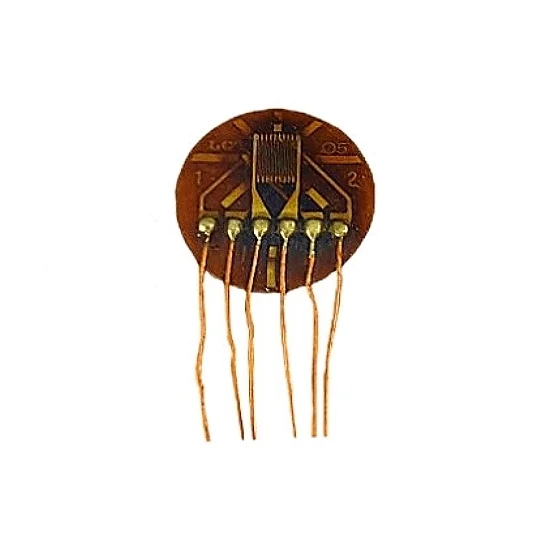
High precision triaxial strain gauge with 0-45-90° design for comprehensive PCB testing. Features 120Ω resistance, 2.01 gauge factor, and Φ5mm mini footprint for easy adhesion in confined spaces. Ideal for reliability testing and validation.
Specification
| Model | ATO-YSV312050-11L30M70 |
| Resistance | 120Ω |
| Gauge Factor | 2.01 |
| Accuracy Class | Class A |
| Sensitive Grid Size | 1.2*1.0mm |
| Backing Size | Φ5 mm |
| Measuring Range | 20,000 με |
| Operating Temperature Range | -20℃ to +80℃ |
| Lead Configuration | Enameled wire: 30 mm; PVC insulated wire: 700 mm |
Features
- 3-axis design: This strain gauge features a 0-45-90° 3-axis strain gauge structure engineered for PCB testing, enabling simultaneous measurement of strain components across 3 directions on the PCB board.
- High-Precision Output: The 120Ω strain gauge with a gauge factor of 2.01 delivers stable, accurate signal output, ensuring reliable strain measurement performance.
- Compact and Miniature: Featuring a Φ5mm backing and 1.2×1mm sensitive grid, this miniature PCB strain gauge easily fits confined areas such as pads and component leads without affecting layout or accuracy.
- Composite Lead Design: The strain gaugeombines a 30mm enameled wire with a 700mm PVC-insulated lead. The enameled wire is fine, flexible, and lightweight, ideal for delicate surface soldering on PCBs. The ample PVC lead length facilitates connection to remote data acquisition equipment.
Tips: What are the advantages of triaxial strain gauges?
The triaxial strain gauge (strain flower) integrates three strain-sensitive grids in different directions at a single measurement point, enabling precise capture of the magnitude and direction of principal stresses under complex loading conditions. This fundamentally overcomes the limitation of uniaxial strain gauges, which can only measure strain in a single direction. Its integrated design not only streamlines installation and enhances testing efficiency but also ensures high data accuracy and reliability through measurement errors below 1%, micrometer-level resolution, and self-compensating temperature capabilities. Furthermore, its compact size, lightweight construction, and strong environmental adaptability enable broad application across static and dynamic measurement scenarios—from aerospace structural testing to PCB stress analysis in electronics manufacturing. This makes it a core tool for analyzing the true stress state of components in modern engineering.
Reviews
There are no reviews yet.