
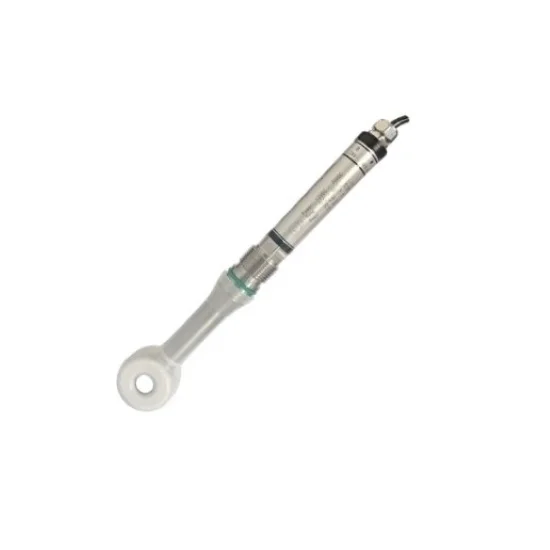
Description
High-quality sanitary inductive conductivity sensor is an ideal solution for industrial process monitoring. Featuring a wide conductivity measurement range of 1 ms/cm to 2000 ms/cm and a temperature range of –20°C to 80°C, it delivers reliable performance across demanding applications. Its lightweight design allows for easy installation, while high measurement accuracy and fast response ensure precise, real-time detection. With excellent corrosion resistance and long-term stability, the toroidal conductivity transmitter is well suited for continuous operation in harsh industrial environments.
Specification
| Model | ATO-CS-DNFA-5 |
| Housing Material | PFA |
| Process Temperature | -20℃ ~ 80℃ |
| Process Pressure | Max 16bar (1.6MPa) |
| Protection Grade | IP68 |
| Connector Type | Connector: G3/4” threaded connection Cable: Integral cable connection |
| Temperature Sensor | Built-in Pt1000 |
| Measuring Range | Conductivity: 1ms/cm ~ 2000ms/cm Temperature: -20℃ ~ 80℃ |
| Accuracy | Conductivity: ±2% reading or ±1 ms/cm whichever is greater Temperature: ±0.5℃ |
| Resolution | Conductivity: 0.01mS/cm Temperature: 0.01℃ |
| Repeatability | Conductivity: 1% Temperature: 0.3℃ |
| Process Connection | Flange: DN75 flange Sleeve: Sanitary grade casing welding type Thread: 2-inch thread Clamp: 2.5-inch chuck |
| Power Supply | 12 VDC ~30VDC |
| Ambient Temperature | -20℃ ~ 50℃ |
| Communication Protocol | Modbus RTU |
| Cable Length | Standard 5 meters |
Features
- The installation method is more comprehensive and in line with the measurement principle.
- The sanitary inductive conductivity sensor has strong anti-interference ability, high accuracy and good stability.
- In low-concentration solutions, the measurement performance is better.
Dimension (Unit: mm)
Wiring
| V+ | V- | A | B |
| 12V~30V positive terminal | 12V~30V negative terminal | RS485_A | RS485_B |
Installation
Flange pipe installation:
Sleeve installation:
Quick connect flange pipe installation:
Application
Tips: FAQ of the conductivity sensor
- Abnormal measurement value: Abnormal measurement value of the conductivity sensor usually manifests as large reading deviation or data drift, which may be caused by incorrect electrode constant setting, calibration failure or electrode contamination. When solving the problem, check whether the electrode constant (K value) in the instrument matches the nominal value of the electrode, and recalibrate with fresh standard solution.
- Sensor response problem: If the conductivity sensor responds slowly or has no signal output, it may be caused by electrode aging, temperature compensation lag or power supply problem. When the activity of the platinum black electrode decreases, it can be activated with nitric acid, and the temperature probe failure needs to be checked or replaced. When there is no signal output, confirm whether the power supply voltage is normal, and use a multimeter to check whether the electrode is open. The inductive sensor coil needs to be replaced if it is damaged, and it is necessary to check whether the cable connection is loose or electromagnetic interference.
- Electrode physical failure: Electrode corrosion, scaling or mechanical damage will directly affect the measurement performance. Strong acid, strong alkali or a high temperature environment may corrode the electrode, and corrosion-resistant materials (such as titanium alloy) need to be replaced. To avoid mechanical impact, industrial scenarios should use sensors with a high protection level (IP68) and check the electrode status regularly.
- Temperature-related failures: Failure of temperature compensation can cause deviations in conductivity sensor readings. Common causes include temperature sensor damage or incorrect compensation coefficient settings. Check whether the temperature probe connection is normal and compare the manual temperature measurement to verify the data accuracy.
Reviews
There are no reviews yet.