
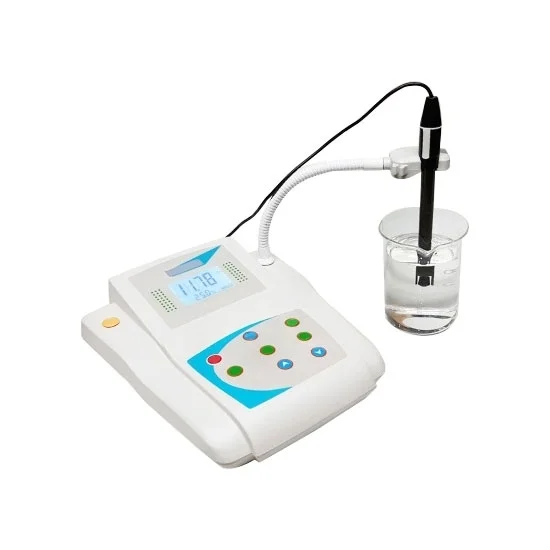
Description
When the ISE generates a voltage proportional to the sodium ion concentration, the ion meter then converts this voltage into a concentration reading, providing accurate and reliable results. Benchtop sodium ion meters are widely used in various scientific and industrial applications, including environmental monitoring, food and beverage analysis, and medical research.
Specification
| Model | ATO-DWS-51 | |
| Measurement Range | mV | -1500~1500 mV |
| pNa | 0~6 pNa | |
| Basic Error of the Electronic Unit | mV | ±0.03% (FS) ±1 digit |
| pNa | ±0.05 pNa | |
| Resolution | mV | 1 mV |
| pNa | 0.01 pNa | |
| Slope Calibration Compensation Range | 40~100% | |
| Electronic Unit Input Current | 1×10-12A | |
| Electronic Unit Input Impedance | 3×10-12Ω | |
| Positioning Calibration Compensation Range | 0-7.00 pNa | |
| Electronic Unit Repeatability Error | ±0.02 pNa | |
| Electronic Unit Stability | ±0.03 pNa | |
| Basic Error | ±0.03 pNa | |
| Repeatability Error | 0.03 pNa | |
| Operating Environment Conditions | Ambient Temperature | 15~35℃ |
| Relative Humidity | 80% | |
| Power Supply Voltage | 220V±22V, Frequency 50±1Hz | |
| Power Consumption | 8VA | |
| Dimensions | 300mm×256mm×110mm | |
| Weight | 1.5kg |
Application
Tips: Can a benchtop sodium ion meter be used only for sodium ISE?
A benchtop sodium ion meter is primarily designed for measuring sodium ion concentrations using an ion-selective electrode (ISE). While it is optimized for accurate and precise sodium ion measurements, its functionality may extend to other ions depending on the specific meter model and available ion-selective electrodes. Some benchtop meters support interchangeable ion-selective electrodes, allowing users to measure concentrations of different ions by swapping electrodes. However, the accuracy and reliability of measurements for ions other than sodium may vary, and it is crucial to use the appropriate calibration standards and electrodes. In summary, while a benchtop sodium ion meter is specialized for sodium measurements, its versatility can be enhanced with compatible ion-selective electrodes, broadening its application to other ions within its technical specifications. Users should consult the instrument’s documentation for guidance on ion compatibility and electrode interchangeability.
Reviews
There are no reviews yet.