
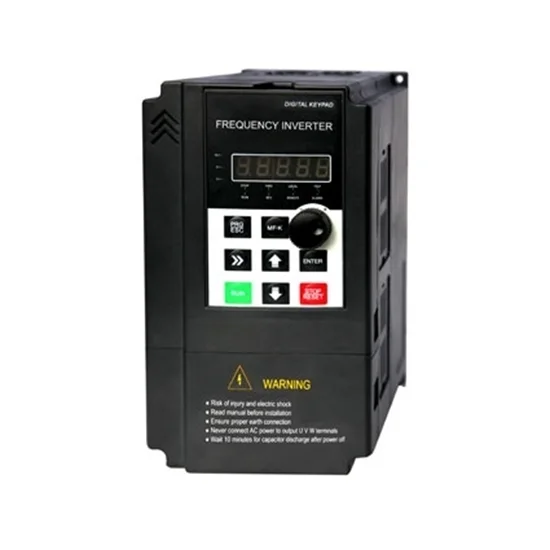
Description
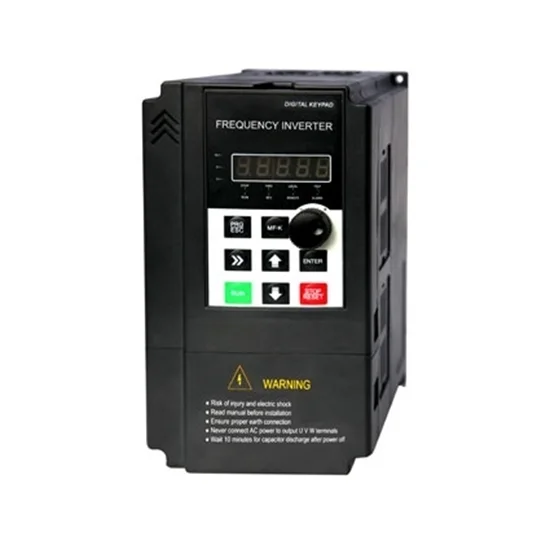
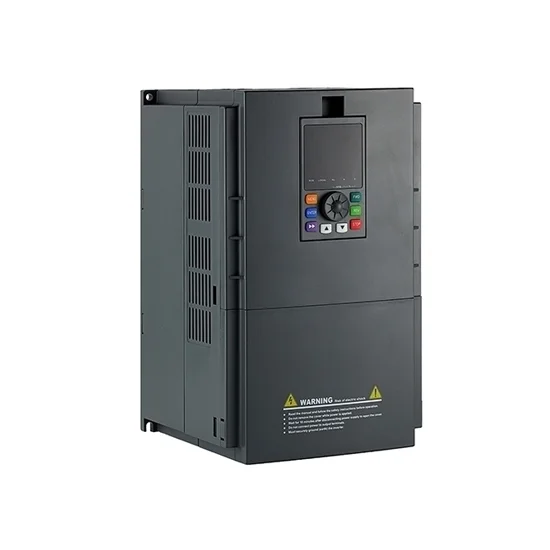
2 hp (1.5 kW) VFD, single phase 110v/120v input to single phase 220v, 230v, 240v output, single phase to three phase, 7 amps.
Specification:
| Basics | Model | EM15-SP1S1-1d5 |
| Capacity | 2 hp (1.5 kW) | |
| Shipping weight | 3 kg | |
| Dimension (W x H x D) | 120*205*166 mm | |
| I/O Feature | Rated current | 7 A |
| Input voltage | 1 phase 120V AC ±15% (Set FE-00=0) | |
| Input frequency | 50Hz/60Hz | |
| Output voltage | 1 phase or 3 phase 220V AC ±15% | |
| Output frequency | 0~320Hz (SFC) | |
| Control Feature | Control mode | V/F control; vector control |
| Communication | Offer RS485 communication interface, support MODBUS-RTU communication protocol | |
| Speed regulation | 1:100 | |
| Start torque | 150% of rating torque at 1 Hz | |
| Speed control accuracy | ≤±0.5% of rating synchronous speed | |
| Frequency precision | Digital setting: max frequency x± 0.01%; | |
| Analog setting: max frequency x± 0.2% | ||
| Frequency resolution | Analog setting: 0.1% of max frequency; | |
| Digital setting: 0.01Hz | ||
| Torque boost | Automatic torque boost, manual torque boost 0.1%~30.0% | |
| Interior PID controller | Be convenient to make closed-loop system | |
| Automatic energy save running | Optimize V/F curve automatically based on the load to realize power save running | |
| Automatic voltage regulation (AVR) | Can keep constant output voltage when power source voltage varies. | |
| Automatic current limiting | Limit running current automatically to avoid frequent over-current which will cause trip | |
| Environment | Enclosure rating | IP 20 |
| Temperature | –10℃~ +40℃; VFD will be derated if ambient temperature exceed 40℃; each rise 1℃, the derate will be 5% | |
| Humidity | smaller than 95%RH, non-condensation | |
| Altitude | ≤1000m; VFD will be derated if above 1000m | |
| Vibration | Less than 5.9 m/s2 (0.6 g) | |
| Cooling | forced air cooling | |
| Store environment | –20℃~ +60℃; no dust, no corrosive gas, no direct sunlight |
Note: ATO VFD Cannot be used as a power source, it Can only be directly connected to an induction motor to control the motor speed.
Details
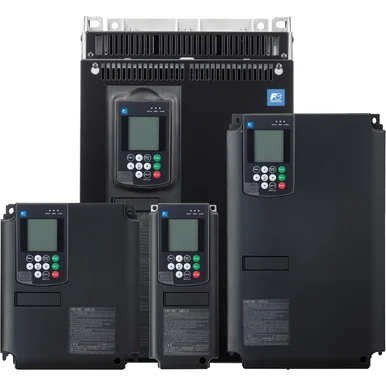
Tips: Variable Frequency Drive vs Soft Starter
If you need to vary the speed of the driven load, then a VFD is definitely the choice. If you are looking to reduce the starting current and the starting torque of an induction motor, then a soft starter can be selected.
If energy savings (reduced speed) is the issue a VFD will almost always be the first choice, but again the driven load, (VT) and application require review and sizing considerations. If speed control is the consideration then a constant torque load will require a VFD. The motor basics we have had to live with, NEMA design A, B, C & D are there for a reason as one design doesn’t fit all applications. The controller is just another tool to use within it’s limitations to provide the desired result for an application.
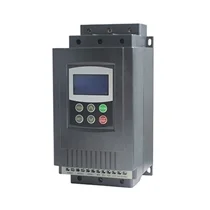
Soft starter – considerably cheaper than VFDs, much more efficient, does not require harmonic mitigation, but draws 3 – 4 times start current and does not offer variable speed feature. Understanding the application and exactly what you are trying to achieve would be the most important factor.
Reviews
There are no reviews yet.