
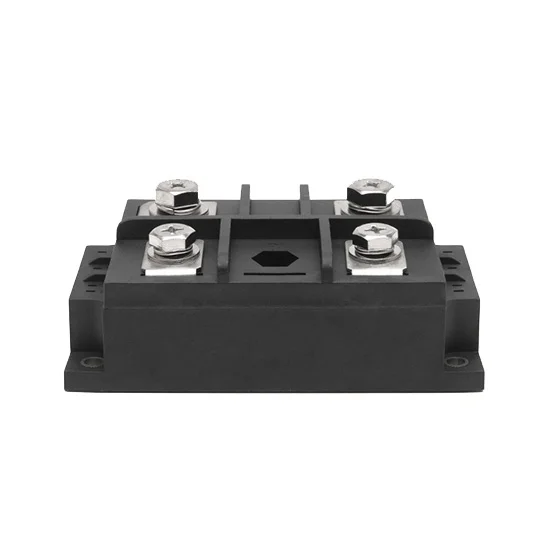
Description
High-power precision bridge rectifier module is widely used in various critical applications, including DC power supplies for instrumentation, input rectification for PWM inverters, inverter welding machines, and DC motor excitation power supplies, among others. It provides stable and efficient DC power conversion in these applications.
Features
- Provide electrical insulation of 2500V voltage between the chip and the substrate to ensure reliable isolation.
- 1-phase bridge rectifier module has excellent temperature characteristics and power cycling capability, and can operate stably under extreme working conditions.
- Its design achieves low forward voltage drop, thereby improving energy efficiency and reducing power loss.
- The bridge rectifier module supports high surge currents to meet the demand for instantaneous high loads.
- The maximum working junction temperature of the equipment can reach 150 ℃, meeting the requirements of high-temperature environments.
- Its compact design makes it small in size and lightweight, making it easy to install and move.
Specification
| Model | ATO-LJ-MDQ300A | ATO-LJ-MDQ400A |
| DC output current | 300A | 400A |
| Reverse repetitive peak voltage | 1600V | |
| Reverse repetitive peak current | 5mA | 5mA |
| Forward non repetitive surge current | 3.6KA | 4.8KA |
| Square time product of surge current | 50A2s*103 | 70A2s*103 |
| Threshold voltage | 0.8V | 0.75V |
| Slope resistance | 3.5mΩ | 2.0mΩ |
| Positive peak voltage | 1.30V | 1.35V |
| Thermal impedance (junction to shell) | 0.14℃/W | 0.10℃/W |
| Thermal impedance (shell to radiator) | 0.07℃/W | 0.07℃/W |
| Insulation voltage | 2500V | |
| Installation torque (M6) | 6N·m | |
| Installation torque (M8) | 10N·m | |
| Storage temperature | -40~125℃ | |
| Weight | 540g |
Note: This product must be installed on a heat sink. Please contact us to choose a suitable heat sink according to the actual situation.
Dimension (mm)
Circuit Diagram
Tips: Differences between rectifier and inverter
Rectifiers and inverters serve distinct functions in power electronics, each tailored to different applications. A rectifier primarily converts alternating current (AC) to direct current (DC), catering to the needs of DC power supplies. Common uses include powering electronic devices, battery chargers, and DC motor drives. Rectifiers operate using components such as diodes, with common configurations being bridge rectifiers and half-wave rectifiers, which efficiently convert AC to stable DC.
In contrast, inverters are designed to convert direct current (DC) into alternating current (AC), enabling the use of DC sources to power AC devices. They are widely employed in solar power systems, uninterruptible power supplies (UPS), and other applications requiring AC power from DC sources. Inverters use switching circuits to produce stable AC voltage and frequency from DC input. Different types of inverters, such as pure sine wave inverters, modified sine wave inverters, and square wave inverters, are available to meet various power requirements and device specifications.
Reviews
There are no reviews yet.