
Description
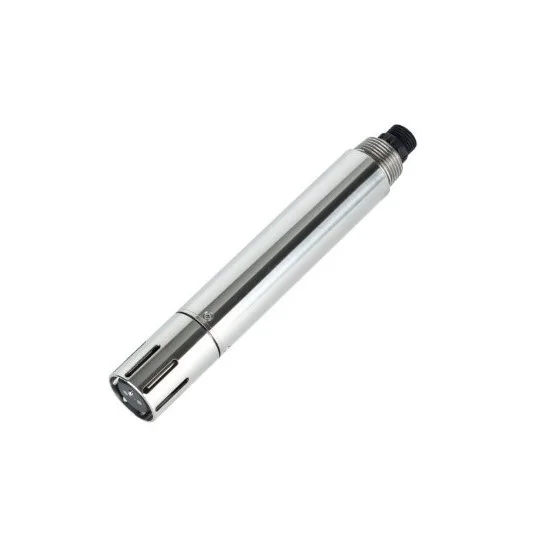
High-quality inline conductivity sensors for liquid have a range of 0~5000μs/cm, an accuracy of ±1.5%F.S. and ±0.3℃, and have the advantages of accurate measurement and stable performance. Inline conductivity transmitters/probes for liquid can be used for surface water environment monitoring, underground pipe network environment monitoring, water supply water monitoring, sewage water monitoring, modern agricultural water quality monitoring, industrial process water quality monitoring, and marine environment monitoring.
Specification
| Model | ATO-DDM-406-S |
| Range | 0~5000μs/cm |
| Resolution | 1μs/cm, 0.1℃ |
| Temperature Compensation | Automatic temperature compensation (Pt1000) |
| Working Temperature | 0~65℃ |
| Output | RS485 (Modbus/RTU), 4-20mA (needs to be equipped with a controller to achieve 4-20mA output) |
| Accuracy | ±1.5%F.S., ±0.3℃ |
| Installation | Immersion installation, 3/4NPT pipe thread |
| Working Pressure | <0.6MPa |
| Cable Length | 5 meters, please contact us for other lengths |
| Calibration | Two-point calibration |
| Power Supply | 12~24VDC |
| Power Consumption | 0.2W@12V |
| Casing Material | ABS, POM, 616L stainless steel |
| Protection Level | IP68 |
| Weight | 0.35kg |
Controller
| Display | 2.8-inch monochrome LCD |
| Dimensions | 101×105×128 mm |
| Opening Size | 93×93 mm |
| Measured Variables | According to the sensor definition |
| Current Output | 4-20mA corresponding parameters and temperature measurement range can be set |
| RS485 Output | Modbus RTU communication protocol |
| Alarm Function | 2 channels, capacity AC 250V/3A |
| Relative Humidity | 10~90%RH (no condensation) |
| Working Temperature | 0~60℃ |
| Power Supply | AC: 220V±10%, 50Hz/60Hz 110V±10%, 50Hz/60Hz |
| Power Consumption | 5W |
| Storage Conditions Temperature | 0~60℃ |
| Relative Humidity | 10-90%RH (no condensation), altitude: <2000m |
| Weight | 0.58 kg |
Features
- The inline conductivity sensor uses a contact-type stable graphite electrode with a wide contact area and is not easily polarized.
- Built-in temperature sensor to ensure measurement accuracy and good long-term stability.
- RS485 communication interface, standard Modbus protocol, 4-20mA current output for easy integration of third-party devices
Dimension (Unit: mm)
Details
Application
Tips: Applications of conductivity sensors
- Water quality monitoring: Conductivity transducers play an important role in water quality monitoring, used to assess the purity and contamination of water. High conductivity may indicate that a large amount of salts or pollutants are dissolved in the water, such as industrial wastewater or seawater intrusion into freshwater systems. These sensors are often used for long-term monitoring of rivers, lakes and groundwater, helping environmental protection agencies to detect abnormal water quality in a timely manner.
- Industrial process control: In industries such as chemicals, pharmaceuticals, and food and beverages, conductivity sensors are used to monitor the concentration and composition of solutions during the production process. For example, in the pharmaceutical industry, it is crucial to ensure the precise ratio of reaction solutions; in the food industry, conductivity sensors can detect the salt content in milk or the sugar content of beverages to ensure product consistency.
- Agricultural irrigation: In modern agriculture, conductivity sensors are used to monitor the salt content of soil and irrigation water. High salt content can damage crop growth, so real-time monitoring can help farmers adjust irrigation strategies, use more suitable water sources or take soil flushing measures to increase crop yields.
- Laboratory research: In scientific research, conductivity transmitters are used in a variety of experiments, such as monitoring the progress of chemical reactions or testing cell culture fluids in biological research. Their high accuracy and fast response characteristics make them an indispensable tool in laboratories.
- Drinking water treatment: Water plants use conductivity sensors to ensure the safety of drinking water. By monitoring changes in the conductivity of water during treatment, filtration and disinfection steps can be optimized to prevent harmful substances from exceeding standards, while detecting pollutant leaks in pipes.
- Desalination: In desalination plants, conductivity sensors are used to monitor water quality before and after treatment. After desalination, the conductivity of high-salinity seawater is significantly reduced, and the sensors ensure that the salt content of the produced water meets drinkable standards.
- Environmental science research: In environmental monitoring stations and ecological studies, conductivity sensors are used to assess the health of natural water bodies. Long-term data collection helps analyze the impact of climate change or human activities on aquatic ecosystems.
Reviews
There are no reviews yet.