
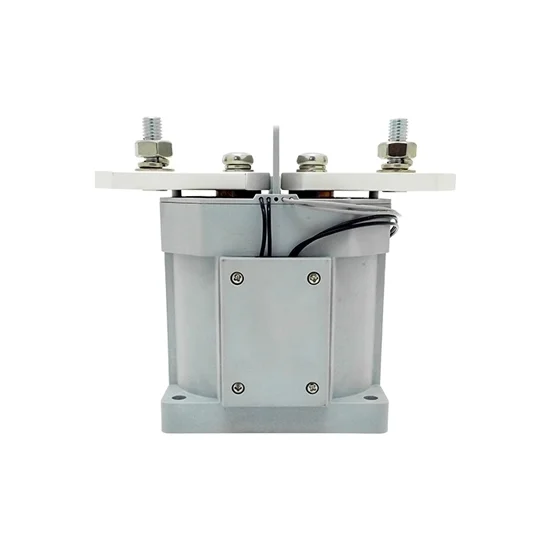
Description
Hot sale 1200A high voltage DC contactor has a 9-36 coil voltage, NO main contact form, non-polarity, and NO or NC auxiliary contact, widely used in new energy vehicles, energy storage and photovoltaic systems, DC charging stations, and industrial, rail transportation, etc.
Features
- 1200A DC contactor adopts high-strength epoxy resin sealing with nitrogen-based gas filling, eliminating arc leakage risks, preventing contact oxidation, and ensuring safe operation without fire or explosion during its service life.
- It provides reliable performance with 1200A continuous current at 85℃, IP67 contact protection, insulation resistance up to 100MΩ (1000V DC), and dielectric strength of 3.5kV between contacts and coil.
- High voltage DC contactor meets IEC 60664-1, GB/T14048.1, GB/T14048.4 standards, complies with RoHS (2015/863/EU) and REACH (1907/2006/EC), and is certified by CE, CCC, and RoHS.
Specifications
| Model | ATO-ADH-1200J | |
| Main Contact Specification | ||
| Contact Arrangement | 1K (1NO) | |
| Contact Polarity | Non-polarity | |
| Contact Resistance | ≤0.5mΩ (at 20A) | |
| Max. Switching Voltage | 1,000V DC | |
| Max. Breaking Current | 12,000A (1000V DC) 1 Ops | |
| Electrical Endurance (Resistive Load) | 200 Ops (1,000V DC, 1200A) | |
| 500 Ops (750V DC, 1200A) | ||
| 1,000 Ops (500V DC, 1200A) | ||
| Mechanical Endurance | 200,000 Ops | |
| Withstand Current | 1200A, Continuous | |
| 1,440A, 30min | ||
| 1,800A, 15min | ||
| 2,400A, 3min | ||
| 4,800A, 30s | ||
| 7,200A, 500ms | ||
| 24,000A, 5ms | ||
| Performance Parameter (at 23℃) | ||
| Pickup Voltage | See Coil Parameter Tables | |
| Dropout Voltage | See Coil Parameter Tables | |
| Pickup Time | ≤50ms | |
| Contact Bounce Period | ≤5ms | |
| Dropout Time | ≤20ms | |
| Dielectric Strength | Between Main Contacts | 3,500V AC 1min |
| Between Main Contact and Coil | 3,500V DC 1min | |
| Insulation Resistance | Initial State | 100MΩ 1min |
| After Electrical Life | 50MΩ 1 min | |
| Shock | Stability | 20g (Power On) |
| Strength | 20g | |
| Vibration | 5g, 10~500Hz, 1/2 Sine Wave (Power On) | |
| Relative Humidity | 5%~95%RH | |
| Temperature | -40℃~85℃ | |
| Load Terminal | Busbar | |
| Weight | About 3300g | |
| Dimension | 165x106x142mm | |
| Auxiliary Contact Parameter | ||
| Aux. Contact Arrangement | FK/FB (1NO/1NC) | |
| Aux. Contact Rated Current | 3A | |
| Aux. Contact Max. Breaking Voltage | 120V DC | |
| Coil Parameter | ||
| Coil Voltage | 12-36V | |
| Pickup Voltage (DC) | 9-39.6V | |
| Dropout Voltage (DC) | ≥V | |
| Coil Resistance | 1.8Ω±10% | |
| Starting Power | ≤100W (<100ms) | |
| Holding Power | ≤9W |
Dimensions (Unit: mm)
Without Auxiliary Contact
With Auxiliary Contact
Wiring Diagram
Note: A1&A2 main terminals with non-polarity; 3&4 auxiliary contact terminals; 1&2 coil terminals 9-36V.
Applications
High voltage DC contactors are widely applied in electric vehicles (EVs), renewable energy systems (solar and wind), energy storage systems (ESS), DC charging stations, uninterruptible power supplies (UPS), and industrial equipment that requires safe and reliable DC switching.
Tips: Why can’t an AC contactor replace a DC contactor?
AC and DC currents behave very differently when a circuit is opened. In AC systems, the current naturally falls to zero 50 or 60 times per second. This “zero crossing” helps extinguish the arc that forms between the contacts. That is why an AC contactor can safely disconnect current with a relatively simple design.
DC current, however, flows continuously in one direction without any zero crossings. When the contacts open, the arc that forms is much stronger and does not die out naturally. If an AC contactor is used in a DC circuit, the arc may persist, overheat the device, weld the contacts together, or even cause fire.
Therefore, a DC contactor—especially at high current levels like 1200A—must use special designs, such as sealed chambers with insulating gas, magnetic blowouts, or arc-splitting structures, to ensure safe operation.
Reviews
There are no reviews yet.